
Strategy games reward players who recognise patterns, manage uncertainty and learn from their mistakes. Those same habits can make watching UFC fights more engaging, even when no controller is involved.
Rather than opening an event with a borrowed prediction, build your own view, compare it with an AI model and return afterward to examine the differences. The goal is not to turn real athletes into predictable game characters. It is to give your viewing a question worth following.
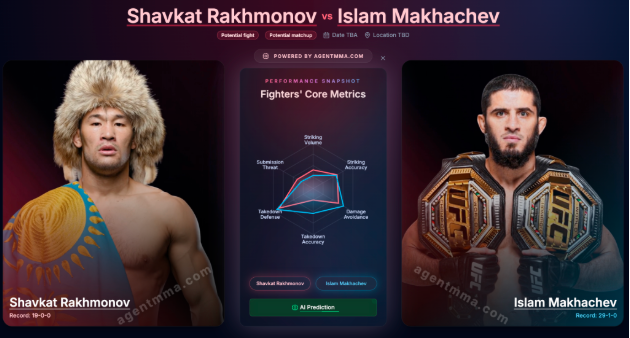
A prediction tool is not a video game
The distinction matters. EA SPORTS UFC 5 uses gameplay systems for damage, striking and submissions. Its action takes place inside a designed environment with rules implemented by the game.
A real-world prediction model estimates an outcome from available information. It does not control either athlete, reproduce every exchange or guarantee that a simulated scenario will occur.
Treating these experiences as interchangeable creates false confidence. A familiar fighter name or an impressive visual interface does not make a forecast reliable. The useful question is what evidence supports the prediction and how it performs beyond selected examples.
Make your own call before seeing the model
Choose one matchup and write a short explanation for each fighter’s winning route. One athlete might need to maintain distance; the other might need to force grappling exchanges. These are hypotheses, not established facts about the result.
Then identify the uncertainty that matters most. Perhaps one fighter has little experience against that style, or recent footage does not reveal how they respond to sustained pressure.
Making this note first gives you something concrete to compare with the model. Otherwise, it is easy to read a confident explanation and mistake it for the view you already held.Read probabilities without turning them into promises
A hypothetical 60% forecast still allows substantial room for the other outcome. It does not mean the predicted fighter should win every exchange, or that an upset would prove the model useless.
The scikit-learn guide to probability calibration explains the broader principle: among many comparable predictions assigned a given probability, observed outcomes should occur at approximately that frequency. Evaluating one fight cannot establish that relationship.
Also distinguish a model score from a probability. Unless the provider explains that a score is calibrated, a rating of 80 out of 100 should not automatically be read as an 80% chance of victory.
Build a repeatable fight-night routine
Explore AgentMMA’s UFC AI predictions to compare your reasoning with its matchup previews and prediction offering. Some detailed analysis requires paid access, so start by reviewing the available information and the platform’s published results.
Keep your original pick, reasoning and confidence in a simple note. During the fight, watch whether the expected tactical questions appear. Afterward, record the outcome without rewriting the original argument to make it look more accurate.
You can make this a friendly challenge without staking money. Agree on the same matches, lock everyone’s picks before the event and compare explanations as well as correct winners. Compare predictions for the same fights over the same period. A record built from selected favourites cannot be fairly contrasted with someone attempting every bout on each card.
Review decisions, not just the scoreboard
A correct pick can come from weak reasoning, while a thoughtful prediction can lose. Ask which assumptions survived contact with the fight and which did not.
Over several events, this creates a useful feedback loop: observe, predict, compare and revise. AI becomes another viewpoint to challenge rather than an answer to obey. For strategy-minded fans, that can make the build-up and the replay discussion as interesting as the result itself.
Oscar Nascimento
 Jo Nguyensenic brought technical expertise and a passion for gaming to the team, helping to refine Play Spotlight’s structure and user experience. His efforts in streamlining content delivery and improving functionality were vital in building a platform that connects and informs the gaming community effectively.